
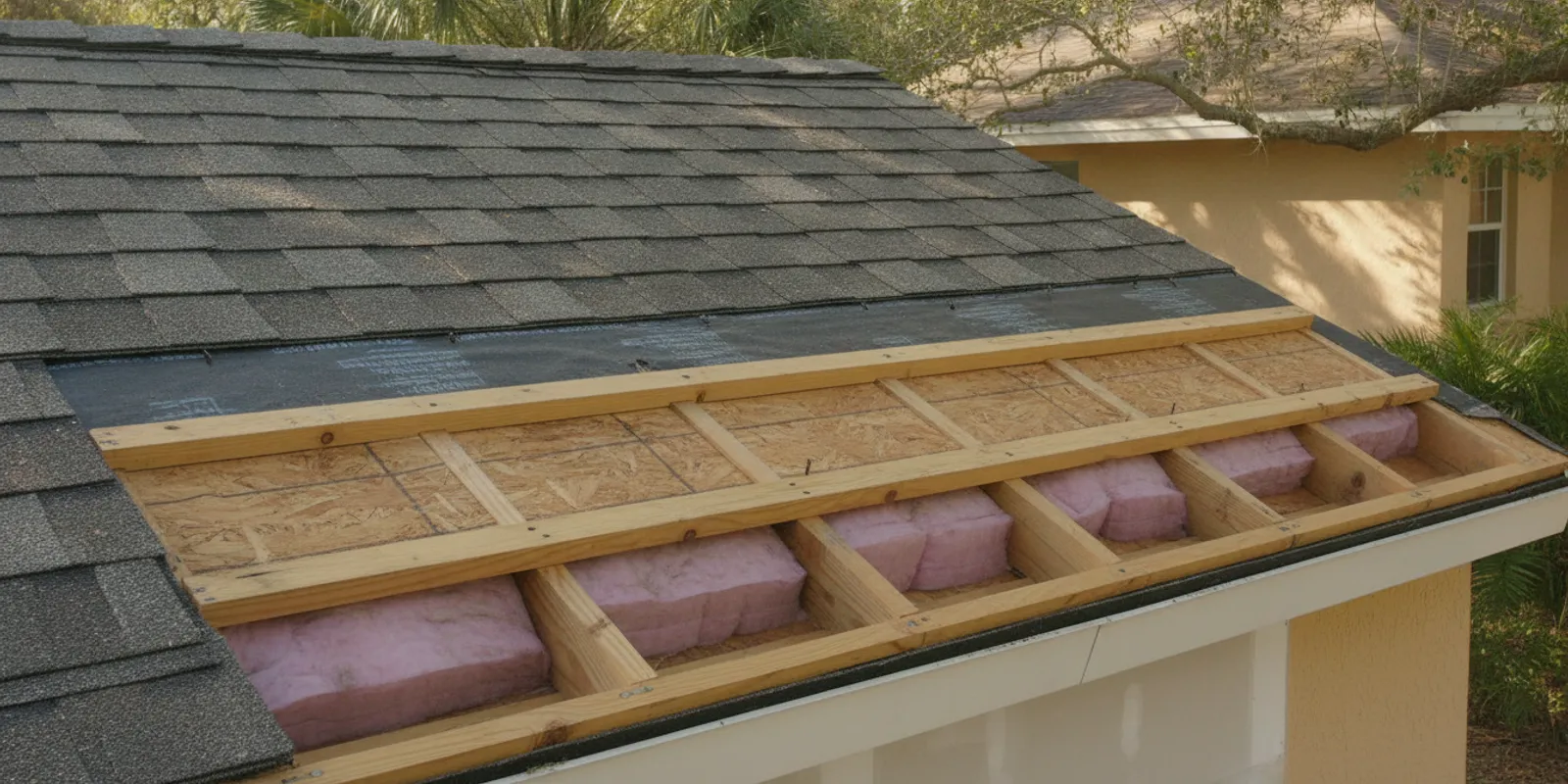
Understanding roof layers explained in plain terms can help you follow an inspection, compare repair options, and understand what a replacement includes. A residential roof is a connected assembly: the visible covering sheds most rain, while the layers and details beneath it help manage water, support the system, and connect it to the house. The exact materials vary by roof design and covering, so a roofer should assess the actual assembly before recommending work.
Request a free roof inspection
What are the main layers of a residential roof?
On a typical sloped home with asphalt shingles, it is useful to picture the roof from the attic outward. Starting at the house, the assembly may include the roof framing, roof deck, underlayment, flashing and other water-management details, and the shingles. Not every component is a continuous sheet across the entire roof. Flashing, for example, is placed at joints and openings where water needs a carefully managed path.
A metal roof or another roof design uses a different covering and may have different supporting details. A flat or low-slope roof also has its own assembly. This overview is a guide to common parts, not a specification for every home or a substitute for checking the roof in person.
| Roof component | Where it is | What it does | What a homeowner can look for |
|---|---|---|---|
| Framing | Below the roof deck | Supports the roof assembly and transfers loads to the structure | From a safe attic vantage point, look for visible sagging, moisture, or damaged wood; do not climb onto framing |
| Roof deck | Above the framing | Provides the base to which roofing materials are attached | Ask whether any soft, damaged, or unsuitable areas need attention when the covering is removed |
| Underlayment | Over the deck, below the covering | Adds a layer beneath the roof covering as part of the water-management system | It is usually concealed; ask what material and installation are included in a replacement |
| Flashing and edge details | At roof joints, penetrations, and edges | Helps manage water at transitions and openings | Look for displaced or visibly damaged details from the ground; leave close inspection to a professional |
| Roof covering | Outermost roof surface | Sheds weather and protects the layers beneath it | Look for missing, lifted, or visibly damaged pieces from a safe location |
| Ventilation and drainage details | At roof openings and edges | Support airflow or move water away from the roof edge, depending on the component | Check for blocked visible openings or overflowing gutters, without assuming one symptom identifies the cause |
What supports the roof covering?
Roof framing
Framing is the structural support below the roof deck. Depending on the home, it may be made up of rafters or prefabricated trusses. It is not a roofing surface, but it matters because the rest of the assembly depends on a sound support structure. A homeowner may see part of the framing from an attic, but should not walk on ceiling joists or trusses unless the space is specifically designed for that use. If you notice visible movement, damage, or persistent dampness, describe what you see to a qualified roofing professional.
Framing is generally not something to diagnose from a quick glance at the roof outside. A roof inspection considers accessible areas and visible conditions, while any structural concern may call for an appropriate specialist. Avoid treating a stain or a small crack as proof of a particular structural problem without an evaluation.
Roof deck or sheathing
The roof deck, often called sheathing, is the surface attached over the framing. Roofing materials are installed over this base, with the exact fastening and assembly depending on the roofing system. In a replacement, the deck may be concealed until old materials are removed. That is why an estimate should explain what happens if the crew finds an area that is damaged or unsuitable beneath the existing roof, including how the condition will be communicated and handled.
From inside an accessible attic, a homeowner may be able to see the underside of the deck. Dark marks, visible dampness, or daylight where it should not be are reasons to ask for a professional assessment. These observations do not establish the cause on their own. Moisture can enter through different parts of a roof assembly or come from a non-roof source, so tracing it matters before work is chosen.
How do underlayment and flashing manage water?
Underlayment
Underlayment is installed over the roof deck and beneath the visible roof covering. It is part of the roof’s layered water-management approach, not a replacement for a properly installed covering or carefully finished details. The type and placement can depend on the roof design and selected system. Because underlayment is hidden after installation, ask the contractor to identify what is included and how it fits the planned roof assembly.
In North Florida, roofs face heat, humidity, and periods of heavy rain and storms. Those conditions make careful installation and sound details important, but no single layer makes a roof immune to weather. For general roofing-system information, homeowners can also consult the National Roofing Contractors Association. For a home-specific explanation, ask a roofer to show which layers are present and what condition they are in.
Flashing and transitions
Flashing is used at transitions and penetrations, such as where a roof meets a wall or where a vent passes through the roof. The precise design depends on the location and roofing material. These areas need particular attention because water does not move across a roof as if the surface were one uninterrupted plane. Valleys, edges, walls, and penetrations all create transitions that must be integrated with the surrounding materials.
It can be hard to judge flashing from the yard. A visible piece that appears bent or displaced is worth mentioning, but the hidden portions and water path may require a closer inspection. Do not pull up roofing, apply caulk, or climb a wet or steep roof to investigate. A quick patch that covers the visible point without identifying how water is getting in may not address the underlying issue.
When comparing repair proposals, ask which location is being addressed, what the proposed work includes, and whether the roofer found related conditions. North Wood’s Roofing offers roof repair and inspections; an on-site evaluation can help distinguish a localized repair from a wider concern.
What does the outer roof covering do?
The roof covering is the part most people see. It is designed to shed weather and protect the underlying assembly. On a shingle roof, individual shingles overlap so water can run down the slope. On a metal roof, the panels and their seams form a different outer system. Each covering has its own installation details and maintenance considerations, so the rest of the assembly should be considered alongside the material itself.
Homeowners comparing these options can review North Wood’s Roofing information about shingle roofs and metal roofs. The right choice depends on the home, existing roof, project goals, and the details of the proposed system. A material name by itself does not explain how the entire roof will be assembled or whether existing layers need to be removed.
From the ground, you may be able to notice missing or visibly lifted pieces, uneven areas, or debris. These signs can justify an inspection, but they do not always show the condition of concealed layers. Do not walk the roof to get a closer look. Roof surfaces can be slippery, and a homeowner may cause damage or fall while trying to inspect them.
Are ventilation, gutters, and skylights roof layers?
Not exactly. Ventilation openings, gutters, and skylights are related to how a roof works, but they are not all continuous layers stacked across the roof deck.
- Ventilation: Roof and attic ventilation components are openings or pathways in a designed system. Their placement and function depend on the house. A homeowner should not assume that adding an opening is always the right fix for a moisture or comfort concern.
- Gutters: Gutters collect and direct water at the roof edge. They are part of the home’s drainage setup, not a waterproof layer beneath the roof covering. Keeping them clear may help water move through the intended route, but gutters do not universally prevent drainage or foundation problems. See the company’s gutter services for information about gutter work.
- Skylights: A skylight interrupts the roof surface and needs the appropriate integration and flashing around it. If you see moisture near one, the source should be evaluated rather than assumed to be the glass alone. Learn about skylight installation and repair.
These parts connect to the roof assembly, so a problem near one may involve nearby materials or a water path that is not obvious from inside the home. A stain on a ceiling, for example, tells you where water became visible, not necessarily where it entered the roof. Share when you first noticed it, whether it changes after rain, and any related observations with the inspector.
How do the layers work together in North Florida?
Think of the roof as a system rather than a stack of independent products. The framing supports the deck. The deck provides the base. Underlayment and the outer covering work together as part of the weather-shedding assembly. Flashing addresses transitions, while edges, openings, ventilation, and drainage components have separate roles. A weakness or installation issue at one point can affect how the broader assembly manages water.
Heat and humidity can affect roofing materials over time, while strong storms can expose weaknesses or cause new damage. That does not mean every roof needs replacement after a storm, or that every leak indicates a failed roof system. Inspection findings, the condition of the covering and accessible layers, and the scope of any affected area help guide the next step. A repair may be appropriate in some situations; replacement may be considered when the overall condition and repair needs point that way.
North Wood’s Roofing is a veteran-owned residential roofing contractor serving Gainesville, Live Oak, Lake City, and North Florida. The company describes its approach as owner-led, with free inspections that include clear photos and no-pressure options. You can learn more about the company and its approach, or see its roofing services.
What should you ask when a roofer explains the roof layers?
Whether you are considering a repair or replacement, a few specific questions can make the discussion easier to follow:
- What did you observe? Ask the roofer to show photos and identify the visible condition, its location, and whether it is confirmed or still needs investigation.
- Which parts of the assembly are included? Ask whether the proposal addresses the covering, underlayment, flashing, edges, penetrations, or another component. Do not rely on a broad phrase like “fix the roof” without a clear scope.
- What is hidden until work begins? Ask how concealed deck or other conditions will be documented and discussed before additional work is done.
- What are the options? Ask whether a targeted repair is reasonable, what it would address, and what concerns would remain. If replacement is recommended, ask why the full assembly or covering should be addressed instead.
- What materials and installation details are proposed? Ask for the names of the materials and a plain explanation of how the parts connect, especially around edges and penetrations.
- What is covered by the written warranty? Review the actual terms and ask which materials or workmanship are covered, for how long, and what exclusions apply. Warranty terms are not all interchangeable; North Wood’s Roofing provides details on its warranty information page.
A clear answer should connect the observed condition to the proposed work without asking you to guess what is included. If you are comparing proposals, compare scope and materials as well as the final line items. A lower or higher total alone does not tell you whether two proposals cover the same work.
Frequently Asked Questions
Does every residential roof have the same layers?
No. The roof covering, slope, openings, construction, and chosen system affect the assembly. A common sloped shingle roof is a useful example, but a metal roof or low-slope roof may use different materials and details. Ask a roofer to explain the actual system on your home.
Can I tell whether underlayment is damaged from the ground?
Usually not. Underlayment is concealed below the outer covering. Visible signs such as missing shingles or an interior stain can prompt an inspection, but they do not establish the condition of the underlayment. A professional assessment is needed to determine what is visible and what may be hidden.
Does a ceiling stain show exactly where the roof is leaking?
Not necessarily. Water can travel before it appears indoors, and a stain can also have a source unrelated to the roof. Note the location and timing, protect belongings if needed, and request an evaluation rather than assuming the entry point based on the stain alone.
Are gutters one of the roof layers?
No. Gutters are attached near the roof edge and help collect and direct runoff. They are part of the drainage setup, separate from layers such as the deck, underlayment, and roof covering.
When should I request an inspection?
Request an evaluation if you notice a leak, visible damage, a change after a storm, or another condition you cannot safely assess. An inspection can help clarify what is visible, what needs attention, and whether repair or further evaluation is appropriate.
Get a clear explanation of your roof
Each roof is different, and the most useful explanation is one tied to the home’s actual materials and condition. If you are unsure what layers your roof has or what a proposed repair includes, ask for a photo-supported inspection and a straightforward description of the options.