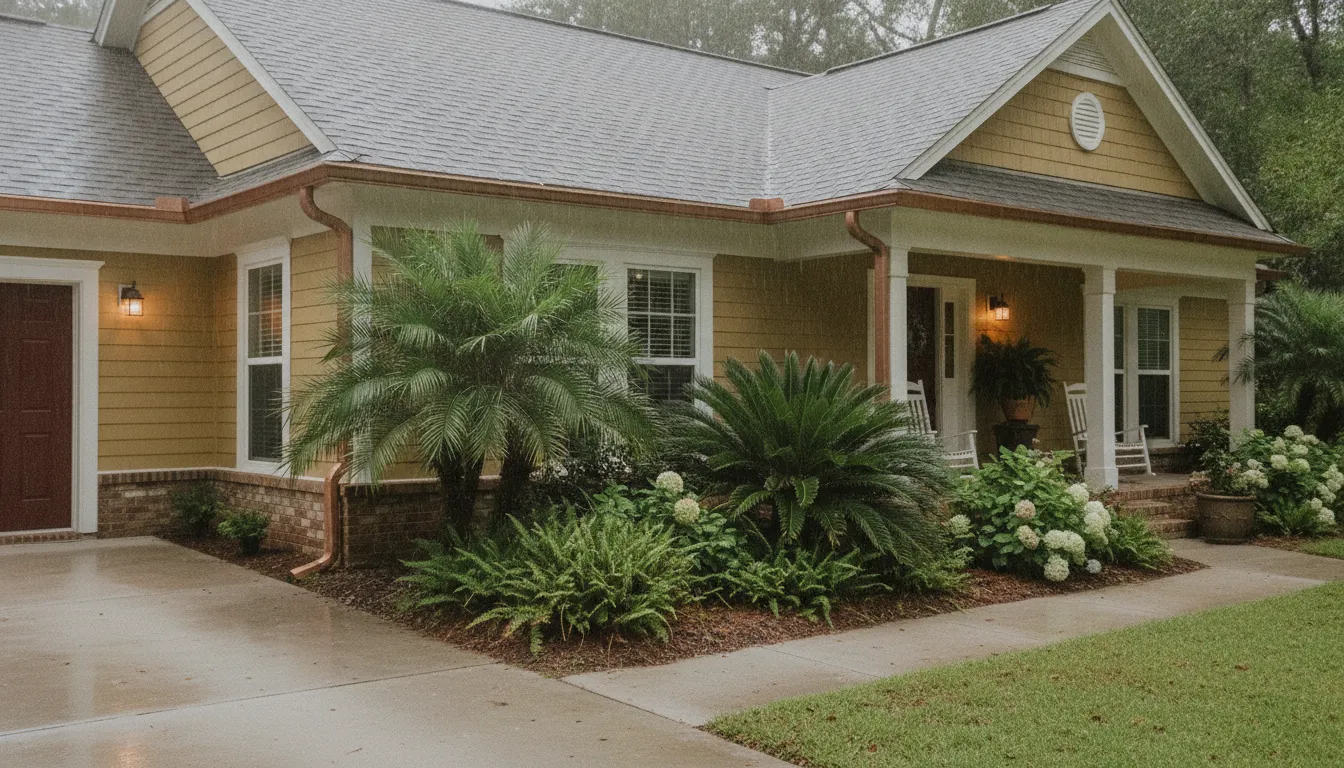
Gutters do more than catch rain at the roof edge. In North Florida, heat, storms, humidity, heavy rain, and tree debris can all affect how runoff moves away from your home. A system that looks adequate may still overflow, sag, or send water toward areas that need attention.
Good gutter installation Florida planning starts with the home itself. Consider roof area and pitch, expected runoff, gutter design, slope, downspout placement, and fascia condition. The way water moves across the property also matters. There is no single size or layout that fits every Gainesville, Live Oak, or Lake City home.
Understanding those local conditions makes it easier to compare options, plan maintenance, and recognize when a repair or replacement deserves a closer look.
Why gutter installation Florida homeowners plan for North Florida conditions
Gutters have a straightforward job. They collect water moving off the roof and guide it toward designated discharge points. That can help manage roof runoff around the home, but a gutter system is not a universal solution for every drainage concern. Its performance depends on design, sizing, slope, condition, downspout layout, roof area, roof pitch, rainfall, and site drainage.
That is why planning matters when you are considering gutter services in North Florida. A layout that works on one home may not be appropriate for another, even when the houses are in the same neighborhood. Roof shape, valleys, corners, existing fascia, landscaping, and the location of suitable discharge areas can all affect the installation. Good planning looks beyond the visible edge of the roof and considers the path water will take after it leaves the downspout.
North Florida weather adds several variables
Homes in Gainesville, Live Oak, Lake City, and surrounding communities experience heat, humidity, storms, heavy rain, and periods of intense roof runoff. Those conditions can expose weak points in a system. Water may overflow when the layout or condition is not suited to the roof. Storms can move leaves and other debris into gutters. Nearby trees can also add maintenance between inspections. Heat and moisture make it important to watch the roof edge, fasteners, seals, fascia, and soffit.
Overflow is not automatically proof that the entire system needs replacement. It may relate to debris, a blocked or poorly placed downspout, an incorrect slope, a damaged section, or site drainage beyond the gutter itself. An evaluation can separate a maintenance issue from a layout or condition problem. It can also identify roof-edge, fascia, or soffit concerns that deserve attention before they become more extensive.
Plan for the property, not just the roofline
Effective gutter planning connects roof runoff to the rest of the property. Consider downspout locations alongside walkways, entrances, landscaping, and areas where water already collects. The goal is to direct water appropriately. It is not to promise that gutters alone will prevent foundation, soil, or drainage problems. Those outcomes depend on the system, the site, and how water behaves beyond the home.
For homeowners comparing installation, repair, or replacement, a photo-documented review and clear explanation can make the next step easier. North Wood’s Roofing serves North Florida homeowners with an owner-led, no-pressure approach. The recommendation can match the actual condition of the roof edge and drainage system rather than a one-size-fits-all assumption.
Which gutter system is right for a Florida home?
There is no single gutter setup that fits every Florida home. A roofline with several corners, a steep section, heavy tree cover, or difficult downspout routing may call for a different approach than a simple one-story roof. When comparing options, look beyond the channel itself. Materials, joints, attachment points, fascia condition, and maintenance access all affect how practical the system will be over time.
Sectional versus seamless gutters
Sectional gutters arrive in shorter lengths and are joined at corners and connection points during installation. They can be a reasonable choice for a straightforward repair or a limited replacement, especially when the existing system is otherwise sound. Their joints need careful sealing and inspection because each connection is a potential location for a leak or separation.
Seamless gutters are formed in longer runs to fit the measured roofline, which reduces the number of joints along straight sections. Fewer joints can mean fewer seam-related repair points, but seamless construction does not correct poor slope, inadequate downspout placement, weak fascia, or an unsuitable layout. Installation quality and the condition of the home still matter.
| Factor | Sectional system | Seamless system |
|---|---|---|
| Joints | More connections along the gutter run require sound seals and periodic inspection. | Longer formed runs have fewer joints on straight roofline sections. |
| Appearance | Connection points may be more visible, depending on the roofline and finish. | Continuous runs can create a cleaner look along the edge of the home. |
| Repairs | An isolated section or joint may be replaceable without changing an entire run. | A local issue may still be repairable, but the installer should assess the full run and its attachments. |
| Planning | Works best when sections, corners, slope, and downspouts are measured and connected carefully. | Requires accurate roofline measurements and a sound surface for secure attachment. |
Materials and gutter guards
Material selection should account for the home’s appearance, roof edge, exposure, and maintenance expectations. The right choice is not simply the heaviest or most expensive option. A contractor should also inspect the fascia before attachment. If the supporting wood is deteriorated, installing new gutters over it may leave the underlying problem unresolved.
Gutter guards can reduce the amount of leaves and debris entering a system, but they do not make maintenance unnecessary. Their suitability depends on nearby trees, roof design, debris type, and how water reaches the gutter. Ask how the guard will be accessed for inspection and how the system handles heavy rain. For a North Florida home, a careful evaluation is more useful than a universal product recommendation.
How gutter sizing and downspout layout are determined
There is no universal gutter measurement or one-size-fits-all rule for Florida homes. A system that works on one roofline may be poorly matched to another, even on the same street. Proper planning starts with the way water reaches the edge of the roof, then follows that water through the gutters, outlets, downspouts, and surrounding drainage area.
Roof area is one of the first considerations. Larger roof sections can collect more runoff, while a steep pitch can move water toward the edge with greater speed. Rainfall patterns and the intensity of a storm also matter, particularly in North Florida, where heavy rain can arrive quickly. These factors are considered together rather than treated as separate checkboxes.
The gutter profile is part of that decision. Its shape and capacity need to suit the roof area and expected runoff, but the appropriate choice depends on the home and installation conditions. Exact dimensions should be selected from a project-specific assessment, not copied from a generic recommendation online.
Why the roofline and outlets matter
Layout affects performance just as much as the gutter itself. Long runs, inside and outside corners, valleys, and changes in roof direction can concentrate water in particular areas. Installers consider where outlets can be placed and how downspouts can carry water away without creating a new problem at the base of the wall.
Downspout placement should account for the roof sections feeding each run, the available discharge areas, and the site’s existing drainage. Gutters may help direct roof runoff, but they do not automatically solve standing water or protect every foundation area. Soil, grading, hard surfaces, landscaping, and the distance water travels after leaving the downspout all influence the result.
The roof edge also deserves attention before any new system is installed. Damaged or soft fascia can affect how gutters are supported, while soffit and fascia staining may point to recurring overflow or leakage. A careful evaluation can identify whether the drainage layout, the supporting wood, or another roof-edge condition needs attention first.
Finally, maintenance is part of the layout conversation. Leaves, pine needles, and storm debris can reduce the working capacity of a correctly planned system. Review how often to clean gutters for practical guidance, then adjust the plan to the trees and conditions around your home. For homeowners in Gainesville, Live Oak, Lake City, and nearby communities. A site-specific review is the reliable way to match gutter sizing and downspout layout to the actual roof and drainage conditions.
What happens during professional gutter installation?
A professional installation is more than fastening a channel along the roof edge. The installer needs to understand how water leaves each roof section, where it should be directed, and whether the existing roof edge can support the planned system. That matters for homes across Gainesville, Live Oak, Lake City, and surrounding North Florida communities. Heavy rain, storms, humidity, and tree debris can all affect drainage.
- Inspect the roofline and surrounding drainage areas. The process starts with a close look at the roof edges, fascia, soffit, existing gutters, downspouts, corners, valleys, and discharge areas. The goal is to identify visible deterioration, poor attachment points, staining, or places where runoff may be concentrating. A gutter system can only perform as intended when its design fits the roof and site conditions.
- Measure the roofline and map the water path. The installer measures gutter runs, notes roof sections and corners, and identifies practical locations for outlets and downspouts. Roof area, pitch, rainfall and runoff patterns, gutter profile, slope, and the surrounding grade all influence the layout. There is no single size or downspout arrangement that fits every Florida home.
- Remove an existing system when needed. If old gutters are being replaced, the crew removes failing sections, loose hangers, damaged seals, and other components that should not remain beneath the new installation. Removal also provides a clearer view of the fascia and soffit. Any concealed or newly visible concern should be documented and discussed before it is covered.
- Check the fascia, soffit, and attachment points. Fascia is the board along the roof edge where many gutter hangers attach. The installer checks whether it appears sound enough for secure fastening and looks for signs of drainage-related wear around the soffit and roof edge. If repair or additional evaluation is appropriate, that should be addressed as part of the project scope rather than assumed away.
- Set the custom layout and attach the gutters. Gutters are positioned to follow the planned roofline and slope toward their outlets. Hangers and fasteners are placed to support the system, while corners and end caps are fitted to match the layout. Where sections join, the installer seals the connections carefully. The objective is a stable, continuous path for runoff, not simply a visually straight line.
- Install and direct the downspouts. Downspouts connect the upper gutter runs to suitable discharge points. Elbows, outlets, and extensions are arranged so water does not simply collect beside the home. Final discharge depends on the property, grade, and existing drainage. So the installer should explain how the completed system is intended to move water away from the roof edge.
- Verify water flow and clean the work area. The final review checks that gutters are secure, connections are sealed, outlets are open, and water can travel through the planned route without obvious pooling or obstruction. The crew should remove installation debris and leave the roofline and surrounding area orderly. Ask for photos and clear notes about any recommended follow-up, especially if fascia, soffit, or site drainage concerns were observed.
How should Florida homeowners maintain gutters through the year?
North Florida gutters deal with changing conditions rather than one predictable season. Heat, humidity, heavy rain, storms, and tree debris can all affect how well a system moves roof runoff. A practical maintenance plan should follow your property, roof design, and weather patterns instead of an arbitrary calendar. Homes under mature trees may need attention sooner than homes with little surrounding vegetation. While roof shape, gutter condition, and downspout layout can change what you see after a storm.
Before the heavier rain periods
- Look along the roof edge for leaves, pine needles, and other debris that could restrict water entry.
- Check visible gutters and downspouts for sagging, separation, cracks, holes, or signs that sections are pulling away from the fascia.
- Look for staining on the fascia or soffit and note areas where water appears to collect near the home.
- Confirm that downspout outlets are not blocked and that discharged water has a reasonable path away from the house. Gutters can help direct runoff, but the result depends on the entire drainage setup and site conditions.
Do not lean a ladder against unstable gutter sections or climb onto a wet roof to inspect a problem. From the ground, binoculars can help you spot obvious issues. If the roof edge, ladder position, or storm damage makes inspection unsafe, arrange a professional assessment instead.
After storms and during leaf fall
After strong weather, check for new overflow marks, displaced sections, loose fasteners, and debris packed into corners or outlets. Heavy rain can reveal problems that are not obvious on a dry day, including water spilling over one section or backing up at a downspout. During periods of falling leaves or persistent debris, inspect based on what your property is collecting, not on a universal monthly rule. Clear buildup before it becomes compacted, and pay special attention to valleys, inside corners, and areas beneath overhanging branches.
For more detail on deciding how often to clean gutters, use the existing North Florida cleaning guide as a starting point, then adjust the timing to your trees, roof, and observed debris. Cleaning alone may not address a damaged slope, undersized layout, failing seal, or drainage issue elsewhere on the property.
When a broader check makes sense
If you are already arranging roof maintenance, North Wood’s Roofing’s roof tune-up and gutter blowout includes a gutter blowout, full inspection, and photo report. That service is a roof maintenance option, not a transfer of its price to gutter installation or replacement. A photo-documented review can help clarify whether the next step is cleaning, a focused repair, or a broader evaluation of the roof edge, fascia, soffit, and drainage conditions.
When should you repair gutters or replace the system?
Gutter problems do not automatically mean the entire system needs to be replaced. An isolated leak, loose fastener, or small section of damage may be repairable, especially when the rest of the roofline, gutters, and downspouts remain in sound condition. On the other hand, repeated failures across several sections can indicate that patching is only postponing a larger solution.
Signs a repair may be enough
Look for a specific problem rather than assuming the whole system has failed. A small crack or hole in one section, a separated joint. Or a short area that is pulling away may be addressed with a targeted repair when the surrounding material is still stable. A gutter that sags in one location could need adjustment, new support, or correction at the fascia rather than complete replacement.
Cleaning can also resolve overflow when leaves, roof granules, or other debris are blocking the channel or downspout. If water flows normally after cleaning and the system holds its shape, replacement may not be necessary. However, overflow that continues after the gutters are clear deserves a closer look. The cause may involve slope, downspout layout, roof runoff, site drainage, or a gutter section that no longer performs as intended.
When replacement deserves consideration
Widespread rust, multiple holes, long cracks, extensive sagging, or gutters that are pulling away along several parts of the roofline point to broader deterioration. Repeated patches are another warning sign. A patch can address a symptom, but a pattern of recurring leaks suggests the material or connections may be failing in more than one place.
Pay attention to the areas around the gutter, too. Staining on the fascia or soffit, soft-looking trim, peeling paint, or recurring dampness can signal that water is escaping where it should not. These signs do not identify the exact cause by themselves, but they justify an inspection of the roof edge and related components. If runoff has contributed to a roof-edge concern, roof repair after runoff damage may be part of the evaluation.
There is no reliable age threshold that applies to every home in Florida. Heat, storms, humidity, debris, installation quality, roof design, and maintenance history all affect condition. A sound decision starts with examining the gutters, fascia, soffit, downspouts, roof runoff, and surrounding drainage together. North Wood’s Roofing can document what is visible and explain whether a focused repair. Additional maintenance, or a new gutter system makes the most practical sense for your North Florida home.
How can you choose a gutter contractor in Gainesville, Live Oak, or Lake City?
Choosing a contractor for gutter installation Florida homeowners can trust starts with the evaluation, not the sales pitch. Whether your home is in Gainesville, Live Oak, Lake City, or a nearby North Florida community. Look for a company that explains what it sees and why it recommends a particular approach.
Ask for a written scope
A useful estimate should describe the work clearly. It should identify the rooflines involved, the gutter material and profile, downspout locations. Removal of an existing system if needed, sealing or fastening work, cleanup, and any related fascia or soffit concerns. Be cautious of a one-line price that does not explain what is included. The goal is to compare complete scopes, not just totals.
Look for a roofline and drainage assessment
Gutters do not work in isolation. A contractor should consider roof area, pitch, corners, slope, downspout layout, existing gutter condition, and where water will discharge on the property. Site drainage also matters, so no contractor can honestly promise that a new gutter system will prevent every runoff, foundation, or moisture problem. Ask how the proposed layout responds to your home’s actual conditions rather than accepting a universal size or design.
Photos can make the evaluation easier to understand. Look for documentation of roof edges, fascia, soffits, seams, outlets, and areas showing overflow or staining. North Wood’s Roofing describes its service approach as expert diagnosis, photo documentation, clear options, and no-pressure recommendations. You can review its gutter services in North Florida to see how gutter work fits within its residential offerings.
Verify credentials and communication
Before authorizing work, ask whether the contractor carries current general liability and workers’ compensation insurance, and request documentation if needed. Confirm the business is properly licensed for the work it performs. Roofing credentials should not automatically be treated as proof of a separate gutter-specific license. Also ask what materials are available, why one option fits your roofline, and whether repair, cleaning, or replacement are all reasonable choices.
Written warranty terms should be specific to the materials and installation being proposed. Do not rely on a verbal promise, and do not assume every system has the same coverage. Finally, pay attention to the conversation. A trustworthy contractor should answer questions directly, explain limitations, and give you time to decide without pressure. If you want a documented starting point, you can request an honest evaluation and compare the recommendations with your home’s needs.
Frequently Asked Questions
How do you determine the right gutter size for a Florida home?
Gutter sizing is based on the roof area, roof pitch, expected rainfall and runoff, gutter profile, downspout layout, and site conditions. There is no single size that fits every home in Gainesville, Live Oak, Lake City, or elsewhere in North Florida. A proper evaluation also considers roofline details, slope, corners, outlets, and whether the existing fascia can support the system.
Are seamless gutters better than sectional gutters?
Neither option is automatically right for every property. The decision depends on the roofline, installation requirements, material choices, existing condition, and the homeowner’s priorities. A contractor should explain the practical differences, identify where joints or transitions occur, and provide clear options rather than promise that one system will solve every drainage concern.
How often should gutters be cleaned in North Florida?
Cleaning timing depends on nearby trees, roof debris, storms, humidity, and how quickly the system collects leaves or sediment. Inspect gutters after major weather and when you notice overflow or slow drainage. Safe access matters. So a professional inspection or a roof tune-up with gutter blowout may be appropriate when the work is difficult to reach or other roof-edge concerns are present.
Should I repair my gutters or replace the entire system?
Repair may make sense for an isolated leak, loose section, or localized issue. Replacement deserves consideration when the system has widespread rust, cracks, sagging, repeated overflow, recurring leaks, or multiple failed patches. Staining around the fascia or soffit can also signal a broader roof-edge or drainage concern. An inspection can help distinguish a repairable problem from deterioration that requires a larger plan.
Ready to Plan Your Gutter Next Step?
A closer look at the gutters, roof edge, and surrounding drainage conditions can help clarify whether your home needs maintenance, a focused repair, or a broader replacement plan. For a straightforward review without pressure, request an honest evaluation from North Wood’s Roofing. Share what you have noticed, and the team can discuss practical options for your North Florida home.