
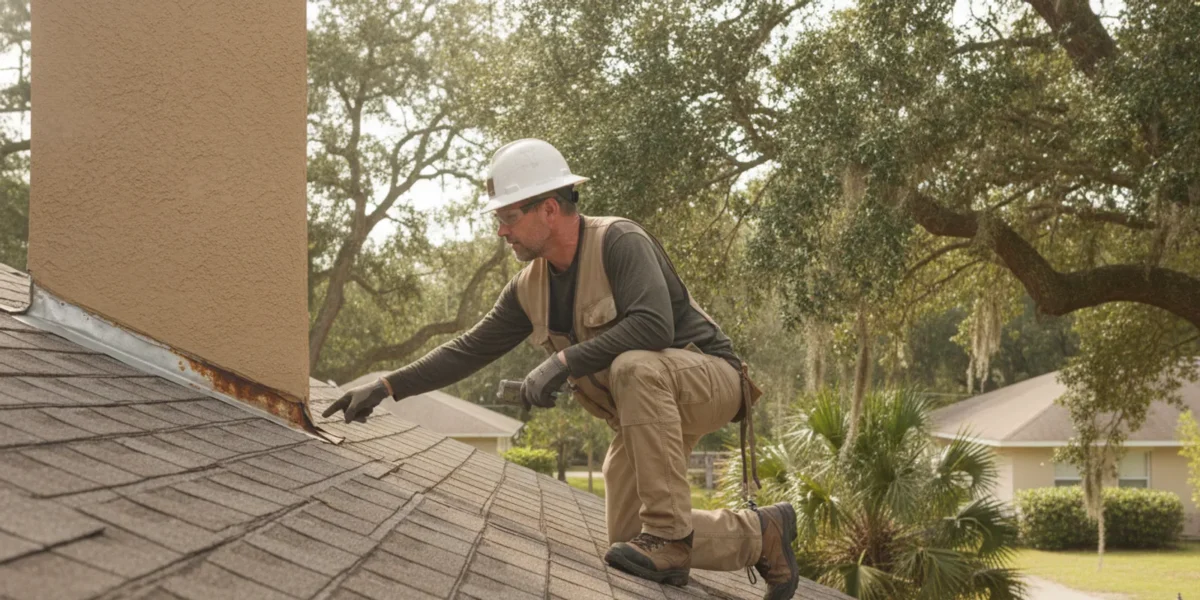
Roof flashing repair in Gainesville, FL, can address leaks where a roof meets a wall, chimney, vent, skylight, or another transition. Flashing helps direct water away from these joints, so a loose or damaged detail may let water reach vulnerable parts of the roof. If you have a leak or suspect a problem, record what you see indoors and arrange an evaluation rather than climbing onto the roof yourself.
Request a free roof inspection
What does roof flashing do?
Flashing is material installed at roof transitions and openings to help guide rainwater away from joints. It may be used where a sloped roof meets a vertical wall, around a chimney, beside a skylight, or around plumbing vents. The exact detail depends on the roof design and the materials involved. Its purpose is not simply to cover a visible seam; flashing has to work together with the surrounding roof covering so water can drain outward.
A roof is an assembly of connected parts. Flashing edges, overlaps, and attachment points need to be integrated with nearby shingles or other roofing material. If a section is bent, loose, corroded, or installed in a way that does not direct water outward, water may find a path beneath the surface. Sealant alone does not necessarily correct a detail that is poorly integrated or damaged.
A stain indoors is not a map of the roof leak. Water can move along decking, framing, or other surfaces before becoming visible, so the point where a ceiling turns brown may be several feet from the entry point. A useful assessment looks at the likely path and the surrounding roof details, rather than assuming the nearest flashing is automatically the cause. For a primer on locations and failure points, read what roof flashing is and where it can fail.
What signs may point to a flashing problem?
Many roof problems can produce similar symptoms. The following signs are reasons to investigate, not proof that flashing is responsible:
- Water stains, peeling paint, or dampness near a ceiling, wall, chimney, or skylight.
- Moisture in an attic near a roof penetration or where the roof meets a wall.
- Drips that appear during rain or shortly afterward.
- Metal that looks lifted, bent, separated, or out of place when viewed safely from the ground.
- A leak that returns after a previous patch or sealant application.
Keep a simple record. Note the date, whether it was raining, how long the water appeared, and the room or area affected. If the leak happens only during certain weather, write that down too; the timing can help an inspector understand what conditions may be involved. Take photos of interior stains or damp areas and any exterior concern visible from the ground. Do not walk on a wet, steep, or damaged roof to get a closer picture.
When describing the problem, separate what you observed from what you suspect. For example, say, “A damp stain appeared on the bedroom ceiling during heavy rain,” rather than stating that a particular flashing detail failed. This gives the roofer useful information without prematurely narrowing the diagnosis. Other possible sources can include shingles, a skylight, or another roof component. North Wood’s Roofing provides roof repair services and can evaluate the concern.
Why can flashing leak in North Florida?
Gainesville and nearby North Florida communities experience heat, humidity, and periods of heavy rain and storms. Roof materials and the joints between them are exposed to weather and can change over time. A flashing problem may also relate to an installation detail, damage during other work, or deterioration in adjacent roofing. The visible symptom alone cannot establish the cause.
Water’s path can make diagnosis less obvious. A roof penetration may be the entry point, while water travels along a surface before reaching the attic or ceiling. A roofer may need to inspect the flashing as well as nearby shingles or other covering, the transition itself, and signs of water impact. Looking only at the interior stain can miss the relevant roof detail; looking only at one piece of metal can miss a problem in the adjoining materials.
Inspection and insurance questions are related but distinct. Florida’s homeowner insurance roof requirements page discusses inspections for some roofs 15 years or older. That information is not a determination of whether a particular policy covers a leak or repair. Review your policy and contact your insurer for guidance about your home and circumstances: Florida’s homeowner insurance roof requirements.
When might a repair be enough?
A focused repair may make sense when the concern is limited to one flashing detail and the surrounding roof materials remain serviceable. A contractor might need to correct or replace a localized component and restore how it meets the adjacent roof covering. The important point is that the proposed work should address the route water is taking, not merely disguise the visible symptom.
Ask the inspector to explain what was observed and how the recommended work responds to it. If the detail must be opened to understand its condition, ask what the contractor expects to examine and how they will discuss any findings that change the scope. A written proposal can identify the location, work, materials, and limitations. It should be clear whether nearby shingles or other roof materials are included.
A repair can be less straightforward if the flashing is tied into deteriorated roofing, if more than one area is affected, or if a prior patch did not hold. Covering a gap with more sealant may leave the underlying issue untouched. Ask what the contractor believes failed, whether the surrounding material can be reused, and what would make the repair unsuitable. North Wood’s offers residential roofing services and free inspections with photo documentation, helping homeowners understand the condition and discuss practical next steps without assuming every leak requires replacement.
How do repair and replacement decisions compare?
The appropriate scope depends on what an inspection finds, the extent of the concern, and the condition of the roof as a whole. This comparison can help organize questions, but it is not a diagnosis or a promise that any particular scope will fit:
| Consideration | Localized flashing repair | Broader roof work |
|---|---|---|
| Possible fit | A specific detail appears to be the source and nearby materials remain workable. | Several areas are involved or surrounding materials also show deterioration. |
| Inspection focus | Flashing, attachment and overlaps, and immediately adjacent roof covering. | The flashing plus the wider roof system, transitions, penetrations, and affected materials. |
| Scope questions | What failed? What will be corrected? How will the repair meet the existing roof? | Which areas need work, why is the larger scope appropriate, and what alternatives exist? |
| Estimate detail | Identify the location, work, materials, and any limits. | List the areas and tasks included, materials, and applicable terms. |
For example, suppose a homeowner notices a stain after rain and the inspection identifies one loose transition while the adjoining covering appears serviceable. The contractor should explain why a localized correction is proposed and what the work entails. In a different case, an inspector may find damage at multiple transitions or deteriorated materials around the suspected entry point. That evidence could support a broader scope, but the estimate should still say which areas are involved and why.
For a roof with widespread age-related concerns, compare a repair recommendation with the overall condition rather than treating one leak as the only factor. Ask the contractor to distinguish necessary work from optional work and show the observations behind the recommendation. If replacement is being discussed, see what homeowners should expect in a roof replacement. A separate option may be a roof tune-up, but maintenance and inspection are not a substitute for evaluating or completing needed repairs.
What should an inspection and estimate include?
A useful inspection should explain the observed condition in plain language and connect it to the proposed scope. Ask to see photos when possible. They can help you understand the location and compare the roof detail with the estimate. A written estimate should make clear what is included before you agree to work.
- Location: Which transition, penetration, or roof area is involved?
- Evidence: What observed condition supports the diagnosis? Are there signs of water impact nearby?
- Scope: What will be removed, corrected, replaced, or resealed?
- Adjacent materials: Will surrounding shingles or other roof covering need work?
- Access and limits: What can be confirmed now, what must be opened, and what is excluded?
- Changes: If concealed conditions are found, how will additional work and cost be explained and approved?
- Terms: What workmanship or manufacturer coverage applies to the proposed work?
Compare the descriptions, not only the totals. If one proposal calls for a small repair and another recommends more extensive work, ask each contractor to connect the recommendation to specific inspection findings. Check whether both estimates address the same location, materials, and tasks. A lower total may not represent the same scope, and a larger scope should be supported by a clear explanation.
Before deciding, you can use this short comparison process:
- Mark the suspected location on your own notes and record the symptoms and timing.
- Read each estimate and underline the exact work and materials included.
- List what is excluded or conditional, including how concealed damage would be handled.
- Ask each contractor the same questions about diagnosis, adjacent materials, and applicable terms.
- Take time to review the answers. A clear explanation should help you understand the options without pressure.
North Wood’s Roofing is a veteran-owned residential roofing contractor serving Gainesville, Live Oak, Lake City, and North Florida. The company emphasizes honest pricing, quality workmanship, and no-pressure inspections; learn more about North Wood’s Roofing. You can also review its warranty information and ask which terms apply to the specific work being proposed.
How can you reduce risk while a leak is being evaluated?
If water is entering, move belongings and collect water in a safe container if practical. Keep clear of a sagging ceiling, wet electrical fixtures, and areas where water may be near wiring. Do not climb onto the roof or attempt a repair during rain. If the leak is active, contact a roofing professional promptly and describe where it appears, when it began, and whether there was a recent storm or prior repair.
Temporary steps do not establish the cause or replace an evaluation. Avoid applying sealant over an unknown roof detail; it can obscure the area and may not correct the path water is taking. If you take photos, do so from a safe location and share them with the inspector. A picture of an indoor stain can help communicate the symptom, but it cannot show all the roof conditions needed for a diagnosis.
For homeowners weighing a repair against replacement, avoid making a decision based only on the presence of one stain or one visible metal edge. Ask what the inspector could see, what remains uncertain, and whether the proposed work is limited to the detail or includes related roof materials. This keeps the decision tied to the observed condition instead of assumptions.
What should Gainesville homeowners do next?
Start by documenting the symptoms safely and arranging an inspection that considers both the flashing and nearby roofing. Ask for photos, a specific written scope, and an explanation of whether the issue appears localized or part of a wider concern. If you compare estimates, confirm that each addresses the same area and work. Homeowners in Gainesville, Live Oak, Lake City, and communities in between can use the same process: understand the evidence, clarify the scope, and take time to consider the options.
North Wood’s Roofing offers free roof inspections and estimates with clear photos and no-pressure options. You can schedule a free estimate to discuss the roof’s condition and possible next steps.
Frequently asked questions about roof flashing repair
Can a flashing leak cause a ceiling stain far from the entry point?
Yes. Water may travel along roof or framing surfaces before appearing indoors, so a stain may not be directly below the entry point. An inspection is needed to trace the likely source.
Does every flashing problem require roof replacement?
No. A limited issue may be repairable, while damage involving multiple areas or surrounding materials may call for a broader scope. The decision depends on inspection findings and the roof’s overall condition.
Can I inspect roof flashing myself?
You can note indoor symptoms and look from the ground if the view is safe. Do not climb onto a wet, steep, or damaged roof; a roofing professional can assess the detail from a safer position.
What information should I provide when requesting an inspection?
Describe where water appears, when it happens, whether it followed a storm, and any prior repair. Photos of indoor symptoms may help explain the concern, but they do not replace an evaluation of the roof.
A careful inspection and written explanation can help you decide whether a localized flashing repair or broader roofing work fits the condition of your Gainesville-area home.